
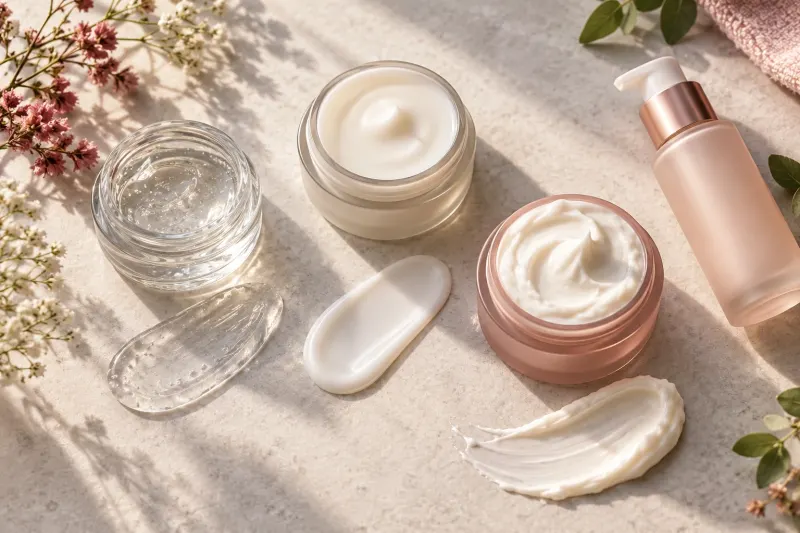
You’ve probably had at least one moisturizer that felt wrong. It sat on your skin like a layer of grease. Or it vanished in seconds and your face felt tight again by lunch. Or it stayed tacky, so your hair stuck to your cheeks every time you turned your head.
When that happens, it’s tempting to blame the brand, or to decide that moisturizer just “doesn’t work” for you. More often, the problem is simpler: the texture didn’t match your skin. A rich cream can be exactly right for one person and far too heavy for another. A light gel can be perfect in July and not nearly enough in January.
The good news is that you don’t need to know much chemistry to choose better. If you know roughly how your skin behaves and what the different textures are designed to do, you can narrow the shelf down to a handful of sensible options.
What a moisturizer actually does
A moisturizer has two basic jobs: help your skin hold on to water, and make it feel soft and comfortable. Most formulas do that with a mix of three kinds of ingredients:
- Humectants draw water into the top layer of skin. Glycerin and hyaluronic acid are two you’ll see often.
- Emollients smooth and soften, filling in the tiny rough spots that make skin feel dry. Squalane and many plant oils fall into this group.
- Occlusives form a light seal that slows down water loss. Petrolatum, dimethicone and shea butter are common examples.
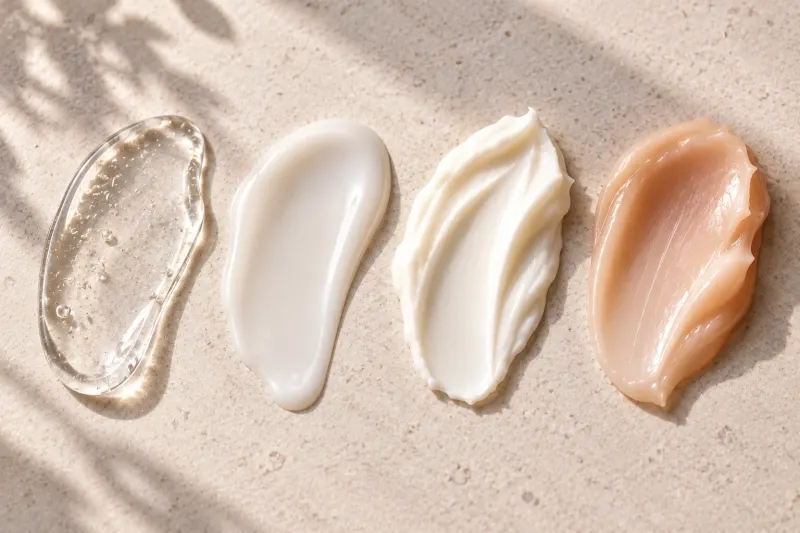
Every moisturizer balances these differently, and that balance is a big part of what you feel as “texture.” A water-based gel leans on humectants. A thick cream or balm leans on emollients and occlusives. Neither is better. They’re built for different skin and different conditions.
Gel, lotion, cream and balm: what’s the difference?
Gel
Gels are light, often clear or slightly cloudy, and usually water-based with little or no oil. They sink in fast and leave almost nothing behind. That makes them a common pick for oily skin, for combination skin in warm weather, and for anyone who hates the feeling of product on their face.
Gel-cream
A gel-cream sits between a gel and a lotion. It has the bouncy, quick-absorbing feel of a gel with a little more cushion. If gels leave your skin wanting more but lotions feel heavy, this is worth a look.
Lotion
Lotions are thin, easy to spread and contain a bit more oil than gels. They’re a comfortable middle ground for normal and combination skin, and for oily skin in cold or dry weather.
Cream
Creams are thicker and richer, with more emollients and occlusives. They take a little longer to settle and leave skin feeling cushioned. Dry skin often does well with a cream, and many people with other skin types switch to one at night or in winter.
Balm or ointment
Balms are the heaviest option, often made mostly of oils, butters or petrolatum. They’re very good at sealing in moisture, but most people find them too heavy for the whole face every day. They’re more often used on very dry patches, such as around the nose during a cold, or on lips and hands.
How to match a texture to your skin type
Your skin type is the best starting point, because it tells you how much oil your skin already makes. Use this as a guide, not a rule. Climate and personal preference matter too.
| Skin type | Textures to try first | Worth looking for |
|---|---|---|
| Oily | Gel or gel-cream | “Oil-free” or “non-comedogenic” on the label; a lightweight finish |
| Combination | Gel-cream or light lotion | Something light enough for the T-zone; a richer layer on dry cheeks if needed |
| Normal | Lotion or light cream | Whatever feels comfortable; adjust with the seasons |
| Dry | Cream (or lotion in humid weather) | Richer ingredients such as ceramides, shea butter or squalane, alongside glycerin |
If you’re not sure which row is yours, our guide to how to tell what your skin type really is walks through the everyday signs, or you can take the quiz below.
If you have combination skin
Combination skin is where one-size-fits-all advice falls apart, because your T-zone and your cheeks want different things. You have two simple options. Use one light moisturizer all over and add a second, richer layer only where you feel dry. Or use a thin layer on your forehead, nose and chin and a more generous one on your cheeks. You don’t need a special “combination skin” product to do either.
If your skin also gets irritated easily
Sensitivity isn’t a skin type. It can happen with any of them. If products often sting or leave you red, a short ingredient list and a product labeled “fragrance-free” can be a sensible place to start. Note that “unscented” isn’t the same thing: an unscented product can still contain ingredients added to mask other smells.
Not sure of your skin type yet?
Choosing a moisturizer is much easier once you know whether your skin leans oily, dry, combination or normal. The Loviax Skin Type Quiz asks about the same everyday clues covered in this guide, such as how your skin feels after washing and where shine shows up by midday, and weighs them together.
What to check on the label
Moisturizer labels are full of promises. A few details are genuinely useful when you’re choosing:
- The texture words. “Gel,” “gel-cream,” “lotion,” “cream” and “balm” tell you more about how it will feel than most marketing claims do.
- “Non-comedogenic.” This means the product was formulated to be less likely to clog pores. It’s a helpful hint if you’re breakout-prone, but there’s no single official standard for it, so it isn’t a guarantee.
- “Fragrance-free.” Useful if your skin is easily irritated. Remember it isn’t the same as “unscented.”
- SPF in a daytime moisturizer. Convenient, but only if you use enough of it to cover your whole face. The American Academy of Dermatology recommends a broad-spectrum sunscreen with SPF 30 or higher every day. Many people find a separate sunscreen easier to apply generously.
- The first few ingredients. In the US, ingredients are listed from the largest amount to the smallest (those under 1% can appear in any order), so the start of the list gives you a sense of what the formula is mostly made of.
For more on cutting through claims and choosing with a clear head, see our guide to choosing beauty products without getting overwhelmed.
How to tell if a moisturizer is right for you
You’ll usually know within a few days of regular use whether a texture suits you. Check in with your skin a few hours after applying it, not just right away.
- It feels comfortable a few hours later: not tight, not greasy.
- Your makeup or sunscreen goes on smoothly over it and doesn’t slide around or pill.
- You don’t feel the need to reapply during the day (unless you’re in very dry air).
Signs it may be too light
Your skin feels tight or looks flaky by midday, or you keep reaching for more. Try a gel-cream or lotion if you’re using a gel, or a cream if you’re using a lotion.
Signs it may be too heavy
Your face looks shiny soon after applying, makeup slides off, or you notice more clogged pores than usual. Try the next lighter texture, or simply use less.
Why does my skin feel sticky after moisturizing?
A tacky finish usually comes from using a bit too much, or from a formula rich in humectants that hasn’t fully settled yet. Try a smaller amount, apply it while your skin is still slightly damp from cleansing, and give it a minute or two before the next step. If it still feels sticky, a different texture may simply suit you better.
Why is my moisturizer pilling?
Those little rolled-up flakes often appear when there’s more product than your skin can absorb, or when layers are applied too quickly on top of each other. Use less, let each layer settle, and pat rather than rub.
A few habits that make any moisturizer work better
Apply to slightly damp skin
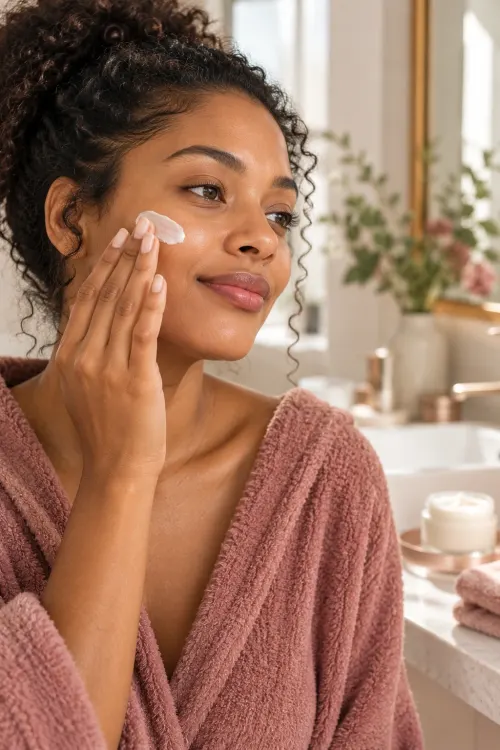
After cleansing, pat your face so it’s damp rather than dripping, then moisturize. This helps lock in some of that water.
Start with less than you think
You can always add a little more. Too much is the most common reason a good moisturizer feels greasy or sticky.
Change one product at a time
If you switch your moisturizer, keep the rest of your routine the same for a while so you can tell how your skin responds.
Adjust with the seasons
Many people use a lighter texture in summer and a richer one in winter. Changing texture isn’t failure; it’s your routine keeping up with the weather.
When to see a professional
If your skin stays dry, cracked or itchy even with a rich moisturizer, if every product seems to sting or burn, or if you have redness or a rash that doesn’t settle, a board-certified dermatologist can help work out what’s going on. A moisturizer can’t treat skin conditions.
Common questions
Does oily skin still need a moisturizer?
Often, yes. Oil and water are different things, and oily skin can still feel dehydrated, especially after cleansing. A light gel or gel-cream can add comfort without adding shine.
Can I use the same moisturizer morning and night?
Yes. Plenty of people use one moisturizer twice a day. Some prefer a lighter one in the morning under sunscreen and makeup and a richer one at night, but it isn’t necessary.
Is a gel-cream just a marketing term?
It describes a real middle texture: lighter than a lotion but with more cushion than a gel. It’s a useful option for combination skin or for switching between seasons.
Can I use body lotion on my face?
It’s usually better not to. Body lotions are often thicker or more fragranced, and they aren’t designed with facial skin in mind. A moisturizer made for the face is a safer choice.
The bottom line
You don’t need the “best” moisturizer. You need one whose texture fits how your skin behaves right now. Start with your skin type, pick the texture that matches it, check how your skin feels a few hours later, and adjust from there: lighter if it’s greasy, richer if it’s tight. If you’re not sure where to begin, the Skin Type Quiz is a quick way to find your starting point.
Want to come back to this later?
Save to Pinterest (opens in a new tab)