
You’ve probably seen the charts: six neat outlines labeled oval, round, square and so on, next to haircuts “for your face shape.” Then you look in the mirror and think, my face doesn’t look like any of those.
That’s completely normal. Real faces aren’t drawn with a ruler, and most of them mix features from more than one shape. This guide will help you work out which shape you’re closest to, which is all you really need.
Why knowing your face shape can be useful
Your face shape isn’t a score, and no shape is better than another. It’s simply a shared vocabulary. It can help you:
- narrow down haircut ideas instead of scrolling endlessly,
- explain to a stylist what you like and don’t like about your current cut,
- choose glasses frames with a little more confidence,
- understand why a style you loved on someone else looked different on you.
Think of it as a starting point for ideas, not a list of things you’re allowed to wear.
Start with three simple observations
Pull your hair back completely, stand in front of a mirror in good light and look straight ahead with a relaxed face. Then ask yourself three questions:
- Is my face longer than it is wide? About the same, a little longer, or clearly longer?
- Which part is widest? Your forehead, your cheekbones or your jaw? Or are they all about the same?
- What does my jawline look like? Soft and rounded, angular with defined corners, or narrowing to a slimmer chin?
Two tricks make this easier. First, trace the outline of your face on the mirror with an old lipstick or a washable eyeliner, then step back and look at the shape on its own. Second, if you use a photo instead, hold the camera at eye level and a little farther away than you would for a selfie. Phone cameras held very close to the face can distort its proportions.
The six common face shapes
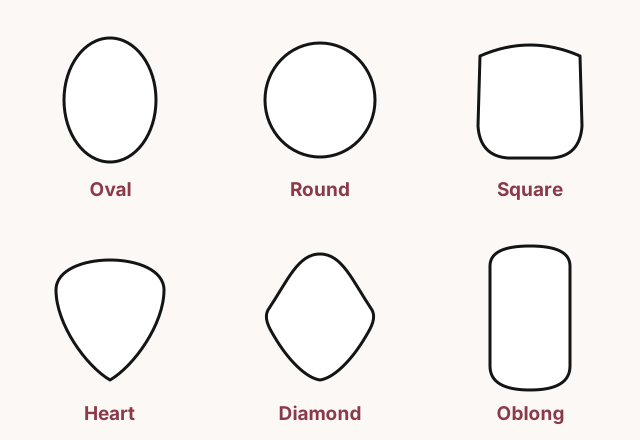
Oval
What it looks like: a little longer than it is wide, widest at the cheekbones, with a forehead slightly wider than the jaw and a softly rounded chin.
Often confused with: oblong, if your face is noticeably long, or round, if your cheeks are fuller and your face is closer to equal length and width.
Round
What it looks like: about as wide as it is long, with full cheeks, a soft jawline and a rounded chin.
Often confused with: square. The difference is the jaw: round faces curve at the corners, while square faces have defined angles.
Square
What it looks like: forehead, cheekbones and jaw are all a similar width, with a strong, angular jaw.
Often confused with: round (check the jaw corners) and oblong (check the length).
Heart
What it looks like: widest at the forehead, narrowing down to a slimmer or pointed chin. Some people with this shape have a widow’s peak.
Often confused with: diamond. Ask yourself whether your forehead or your cheekbones are the widest point.
Diamond
What it looks like: widest at the cheekbones, with a narrower forehead and a narrow chin.
Often confused with: heart and oval. Diamond faces have a noticeably narrow forehead, not just a narrow chin.
Oblong
What it looks like: clearly longer than it is wide, with a similar width from forehead to jaw and fairly straight sides. It’s sometimes called rectangular.
Often confused with: oval (oblong faces have straighter sides) and square (oblong faces are longer).
How to measure your face at home
If you’re stuck between two shapes, a soft measuring tape can help. Measure twice, write the numbers down, and don’t worry about being exact to the millimeter.
- Forehead: across the widest part, from hairline to hairline.
- Cheekbones: across the fullest point, just below the outer corners of your eyes.
- Jawline: from the tip of your chin to just below your ear. Double that number.
- Face length: from the center of your hairline to the tip of your chin.
| If your numbers show… | You may be closest to |
|---|---|
| Length clearly the largest; other widths similar | Oblong |
| Length a little larger; cheekbones widest; jaw a bit narrower than forehead | Oval |
| Length and cheekbone width close; soft jaw | Round |
| Length and width close; all widths similar; angular jaw | Square |
| Forehead widest; jaw narrowest | Heart |
| Cheekbones clearly widest; forehead and jaw both narrow | Diamond |
Measurements narrow things down, but they can’t give you a guaranteed answer. Faces are three-dimensional and curved, and a tape measure only tells part of the story. If your numbers point one way and the mirror points another, trust what you can see.
Why face shape can be hard to identify
If you’ve tried a few online quizzes and got a different answer each time, here’s why:
- Most faces are a mix. Oval-round, heart-oval and square-oblong are all very common combinations.
- Hair hides things. Bangs cover your hairline and forehead, and long hair hides your jaw. Always pull it back.
- Angles and expressions change things. Tilting your head or smiling can make your face look wider or shorter.
- Faces change over time. Your bone structure stays the same, but fullness in the cheeks and jaw can change with age and weight.
If you land between two shapes, that’s not a failure. It just means you get to use ideas from both.
Want a faster starting point?
If measuring isn’t your thing, the Loviax Face Shape Finder asks the same questions in a simpler way: seven quick things to check in the mirror. There’s no photo to upload, and if you’re between two shapes, it tells you which one is “also close.”
What you can explore once you know your face shape
Once you have a rough idea of your shape, you can use it to explore:
- Hairstyles. Our guide to how your face shape can help you explore different hairstyles explains the simple idea behind most face-shape advice, so you can think it through yourself.
- Glasses frames. Many people like frames that contrast with their face shape, such as angular frames on a round face, but any frame you love is a good choice.
- Makeup placement. Where you put blush or bronzer can soften or highlight different areas. More Loviax guides on this are on the way.
Most of all, remember that your face shape describes you. It doesn’t limit you. Use it to find ideas worth trying, then keep the ones that feel like you.
Want to come back to this later?
Save to Pinterest (opens in a new tab)